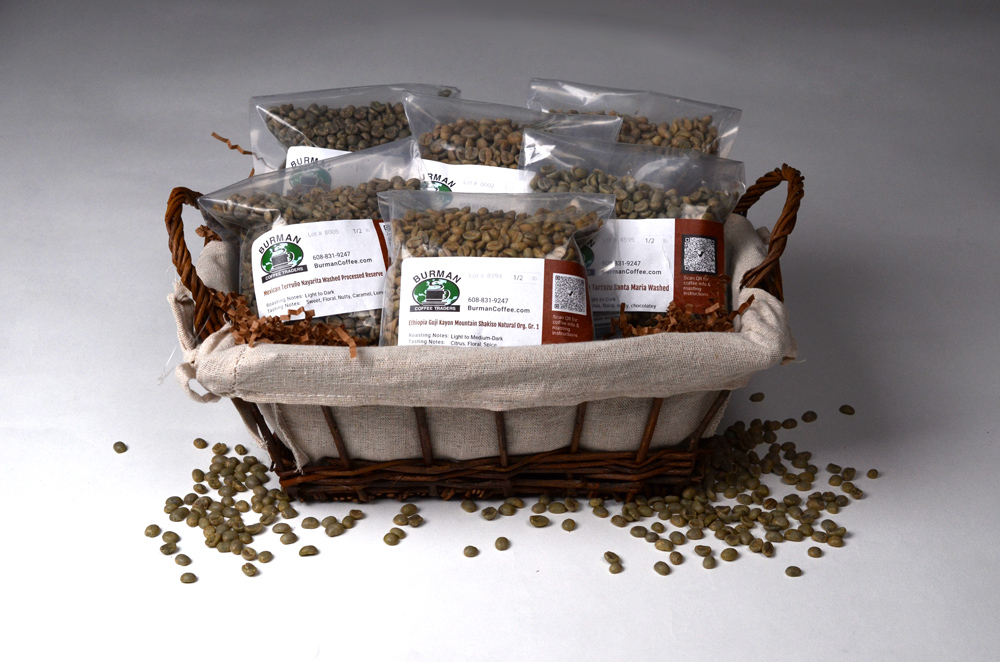
Sampler – 6 Half-Pounds – Burman Coffee Favorites:
$21.59
$28.72
Description Sample some classic coffee flavor profiles from around the world! A half pound each of: Colombian Premium Huila Gigante – Miraflores Juanito Family – Washed This is Sabastian’s family coffee (a wonderful employee at Burman Coffee) a small-batch production air-shipped to offer our customers one of the freshest coffees possible. Processed in early March. Green coffee from a family farm in Miraflores, Gigante municipality (Huila, Colombia): It is a Castillo variety, washed and harvested at altitudes of 1,600–1,900 m, hand-selected. It arrives by air in small batches to preserve its freshness. It presents an exceptionally clean and balanced cup, very versatile depending on the roast: in light coffee, it shows a medium body with caramel and nuts, an intense floral aroma and orange-like citrus with slight herbal and spicy nuances; in medium coffee, it gains structure, with chocolate and a subtle hint of lemon predominating, with a lingering nutty note, lively acidity, and balanced sweetness; in dark coffee, it offers a robust body with deep cocoa and a hint of black tea, while maintaining moderate acidity. Read More Origin: Gigante, Huila – Colombia Family tradition in Every cup Tasting Notes: This coffee stands out for its exceptional quality and cleanliness in every cup. Within its profile, you can discover a range of flavors depending on the roast level. In a light roast, it presents a medium body and reveals an aromatic profile that combines delicate notes of caramel and walnut, intense floral undertones, and vibrant citrus hints of orange. Additionally, its profile is enriched with herbal characteristics and subtle spicy notes, adding complexity and an inviting aroma. Opting for a medium roast enhances its structure while maintaining the purity that defines it. Chocolate notes become more pronounced, complemented by a subtle hint of lemon, while the existing walnut notes remain distinct, even as the coffee cools, ensuring a consistent and balanced experience. This profile also brings out a vibrant acidity that perfectly balances the natural sweetness. For those who prefer a more concentrated flavor profile, a dark roast delivers a robust and bold body, where deep chocolate notes stand out, accompanied by a subtle touch of black tea. It maintains a moderate acidity and exceptional cleanliness, ensuring a refined and full-bodied experience. Roasting Notes: Each roast level highlights different attributes, allowing coffee enthusiasts to appreciate its evolution in aroma, body, and finish. This coffee is versatile at all roast levels, highlighting different tones while still showcasing its excellent quality. Try a lighter roast for more citric floral acidity, or a darker for nuttiness and big body Costa Rican Org. SHB EP Finca Amistad Hacienda la Amistad, located in Coto Brus, a canton in the province of Puntarenas, Costa Rica, is owned and operated by Roberto Montero, a third generation coffee farmer. Roberto’s grandfather first came to the area in the early 1900’s as part of a team surveying the border between Costa Rica and the newly formed country of Panama. Roberto’s grandfather later purchased over 10,000 hectares of land and began to cultivate coffee. Roberto’s family has returned more than 6,000 hectares of land to the government of Costa Rica for the preservation of La Amistad International Park, the largest natural reserve in Central America. Only 300 hectares of land are utilized for coffee cultivation while the remainder of the 4,000 hectare estate is preserved forest teeming with wildlife. Roberto’s commitment to organic farming pairs harmoniously with his commitment to his community. During the coffee harvest, Roberto provides housing and free access to medical care for the seasonal pickers because most are indigenous people from Panama who come to La Amistad with their entire families. Roberto also takes pride in his ability to provide more than 100 full-time jobs to his neighbors from Las Mellizas, not only in coffee cultivation, but also in the dried fruit operation that he runs year round at La Amistad. Roberto hosts an annual employee celebration to recognize all their hard work and he also distributes school supplies to their children each year before school starts. A video from La Amistad available for your viewing HERE. Tasting Notes: This is one you Costa fans will not want to miss; great smooth and clean coffee. A sweet and nutty cup that turns a bit chocolaty as one pushes past a medium roast. Wonderful balance of tones with hints of floral and soft fruit that pop out at most roasts levels. A little herbal spice in the aftertaste. Medium bodied cup with low to medium acidity depending on roast level. A cup everyone should love. Roasting Notes: A shame to roast super dark, will mute up sweetness and all the lighter tones but still tasty. Avoid cinnamon and light roasts, it will not be balanced and taste pretty front loaded with acidity and floral. It shines in the city to full city range. If you like a hint of acidity, a nice city or city roast (lighter side of medium) will be perfect, if you like lower acidity and a little fuller bodied, shoot for right before 2nd crack. (strong medium) Nicaraguan RFA Selva Negra – Honey Processed Selva Negra’s history is in many ways the history of the coffee in Nicaragua altogether. In the 1880’s the Nicaraguan government invited young German immigrants to come and settle in Nicaragua in order to promote coffee growing in the northern highlands. Many accepted the offer, thus forming the main coffee plantations of the country; some estates bear names of their motherlands. Selva Negra means Black Forest, and the coffee estate is called La Hammonia, Latin for Hamburg. Located approximately 4,000 ft. above sea level, La Hammonia has been producing fine old style Arabica coffee for over 100 years. Eddy Kühl & Mausi Kühl-Hayn, the farm’s proprietors are descendants of two of these original German immigrants – Alberto Vogl and Klaus Kühl. Selva Negra Estate Coffee is grown at a high altitude in a shaded environment. This allows the bean to have a slow development cycle which instills an intense and fulfilling flavor to each bean. The coffee is not only 100% Arabica, but more importantly it is mostly Bourbon and Typica strains (which produce higher quality beans than other varieties of coffee trees). The region of Matagalpa, Nicaragua is mountainous with excellent volcanic soil producing exceptional beans. Finally, the coffee is prepared using an environmentally friendly washing process, which gives the coffee still one more unique quality enhancing aspect. Tasting Notes: A nice medium to dark roast more potent Nicaraguan offering. Medium to full bodied with just a little hint of acidity. Strong Medium roasts were our favorite with thicker more complex malty tones, a sweet edge, hints of herbal spice and almost no acidity, a good daily drinker being very smooth. Just a touch of a fruit tone as the cup cools. Darker roasts produce a similar cup but turn it semi-sweet with complimenting smoky tones, not quite as smooth but has the heft many darker roast fans will love. Roasting Notes: Medium to low chaff and even roasting, shoot for right around 2nd crack to start, one can go a little lighter or darker depending on personal taste. Would give it a 48 hour setup to smooth out the cup. Ethiopian Yirgacheffe Natural Gr. 1 – Gedeb Chelchele Gedeb Chelchele is located in Ethiopia’s Gedeo region, part of the Yirgacheffe region, which is often more intense and aromatic than its name suggests. This Natural Grade 1 coffee is made with cherries delivered by small farmers to an independent processing plant, managed by Azeb Tadesse. The plant is situated at a high altitude (1950-2200 meters above sea level) and uses traditional local varieties, resulting in a surprisingly clean profile with a predominance of berry and floral notes. The processing method is the classic Ethiopian natural (dry) method: the whole cherry is dried with the seed inside, which enhances the fruity sweetness as the coffee slowly dries. At Chelchele, the cherries arrive throughout the day, are inspected and graded according to ripeness, and then spread in a single layer on raised beds for drying a method that promotes air circulation and ensures even drying and greater clarity. The coffee is hulled locally and shipped to Addis Ababa for modern dry processing and preparation for export (including color grading and repeated hand sorting). Tasting Notes: Best in the light to medium roast levels. Sweet, semi-fruity and delicate with a little lower acidity levels. The first notes to hit the tongue will be soft and sweet red fruit tones mixing with a apple like acidity, hints of lemon as the cup cools. Pulls some balance with a little nutty/chocolate/spice undertone, not as tea like as many Yirgs, sweet and delicate cup with a more neutral chocolaty dark tone. The acidity and fruity factor are strongest while its super fresh, softens a bit over time, so give it a longer setup if looking for a more neutral daily drinking cup. We also observed that the acidity becomes more apparent as the coffee cools, especially from the second or third day of rest. Overall, the body is medium and silky, and the finish is clean, refreshing, and lingering. Roasting Notes: This is a dense, high-altitude coffee, so it responds best to controlled heat management. Careful going too quickly with the roast, it can hide some of the fruit and delicate feature set. The best results are usually achieved with light to medium roasts, where the red fruit and floral notes remain very prominent. A medium roast is often the ideal: more candied fruit and a more balanced sweetness. If a darker roast is chosen, notes of cocoa may appear, but some of the floral character and that special, sparkling acidity are lost (although they don’t usually disappear completely). Kenya Premium Meru AA – Gichugene Factory – Washed Processed This Meru Gichugene AA coffee from Kenya comes from Meru County, on the northern slopes of Mount Kenya. Unlike the more well-known counties in the south, Meru typically follows a distinct harvest pattern, with two regular harvest windows: April–July (mid-season harvest) and October–December (main harvest). The area is also one of the country’s most productive agricultural and coffee growing regions and is partially surrounded by protected areas (e.g., Meru National Park to the east), which influences the farm types: small plots, cool nights, and local water availability. This lot is produced by 723 smallholder farmers who deliver cherries to the Gichugene Coffee Factory, part of the Katheri Farmers Cooperative Society (FCS). In this system, members elect their representatives and make decisions regarding milling/marketing contracts and profit distribution. Katheri FCS manages four factories (including Gichugene), and in this area, it’s common for each grower to own around 200 trees. Upon arrival, the cherries are hand-selected, weighed, and recorded by the grower; they are then processed and blended to create these types of batches. As for the varieties, Kenyan icons are blended with newer materials: SL28 and SL34 typically contribute the “classic Kenyan” profile of defined citrus and clear sweetness; while Ru Iru 11 (developed to reduce losses from disease following historical crises) and Batian (released in 2010 with rust resistance and CBD) contribute to agronomic stability and a rounder cup. The AA grade corresponds to a larger bean preparation (commonly 17-18 mesh), which many roasters seek for its roasting consistency. Tasting Notes: A fresh and sweet Kenya with a bright touch that isn’t overwhelming. The first impression is of lime and a clean citrus brightness, followed by a soft, nutty sweetness reminiscent of fig rather than jam. As the cup cools, the sweetness shifts towards brown sugar and finishes with a crisp note of dark chocolate with hints of cocoa. The classic SL structure (a clear definition of “tea”) is maintained, while the complementary varieties help keep the sweetness consistent and the finish well-rounded, making this Kenya very easy to enjoy with any brewing method. Roasting Notes: This AA roast is consistent and easy to achieve, and small adjustments to the roast level are welcome. Like many Kenyas, it can show color sooner than expected, so rely more on overall development than appearance. A light to light-medium roast keeps the lime and fig fresh and bright. A medium roast brings out the brown sugar sweetness and makes the cup noticeably smoother. A medium-dark finish intensifies the dark chocolate character, but retains its sweetness if a dry, burnt finish is avoided. A high-bed roast and thorough wash usually result in clarity and a clean aftertaste; strive to achieve this by maintaining a controlled and even roast. Papua New Guinea – Kuta Mill – AA Washed Processed This is a washed AA grade coffee from the Kuta Mill, owned and operated by Brian Leahy, who also uses it for his own estate: Korgua Estate. The estate, which is located on the Kuta Ridge of the Waghi Valley of Papua New Guinea. Leahy’s father first explored this area in the 1930’s, and established Korgua as one of the very first coffee farms in the area. Korgua Estate was created on neutral ground to allow coffee growers from rival tribes to bring their coffees to market without causing disruption. I met Brian at the Mount Hagen club on my adventures through PNG, a night I will never forget. This guy was one of the most knowledgeable coffee heads I have ever met on my journeys. At the time he was managing Kimel Estate, but has since left after he took over his families operations; Kuta mill & Korgua Estate. Lots of smart coffee folk in PNG but many have trouble sticking with it after finding success. A very different life and culture growing coffee in PNG and working with the local tribes. Brian has done a fantastic job and is one of the few we know, who would never leave. This is one of his mill top lots, wonderful tastes and differentiates itself nicely from the Carpenter Estate coffees. A key fact for understanding why the Highlands dominate the current supply is the research and distribution of seeds: in 1937, the Aiyura station was established, where the first Highland coffee was planted with Arabica seeds from Wau, and from there, seed distribution was promoted to different highland areas. In this ecosystem, washing plants and collection centers are the “link” that transforms dispersed production into a repeatable standard. Tasting Notes: A great bean from light to dark. We generally drink it at a medium roast, but with a longer setup, lighter roasts can be a bit sweeter and herbaceous. Darker roast get hefty with chocolate and spice notes. This coffee has a medium-to-full body, a creamy texture, and low to moderate acidity. At a medium roast, a clear base of dark chocolate and toffee/caramel emerges, with layers of dried fruit (date/prune) and a hint of black tea spice that provides structure without becoming overly fruity. In some areas (especially from medium to light roast), a touch of pear and lighter nutty and floral notes may appear. As the roast deepens, the cup becomes more direct: more chocolate, more dark sweetness, and a more toasted finish. Roasting Notes: This coffee performs best at a medium roast, a great balanced daily drinker. (before the second crack). We recommend a little slower roast to accentuate the chocolate and toffee, let them fully develop while reducing the more herbaceous quality of the light roast. If you’re looking for more body for espresso or milk-based drinks, go for a dark roast: it increases the body and deepens the chocolate flavor (making it more “semi-sweet”). At a dark roast (entering the second crack), roasty tones appear with a pleasant smoky accent. To learn more about PNG’s unusual coffee industry, check out our recent blog article “The Wild West of Coffee Production.”
Central America